
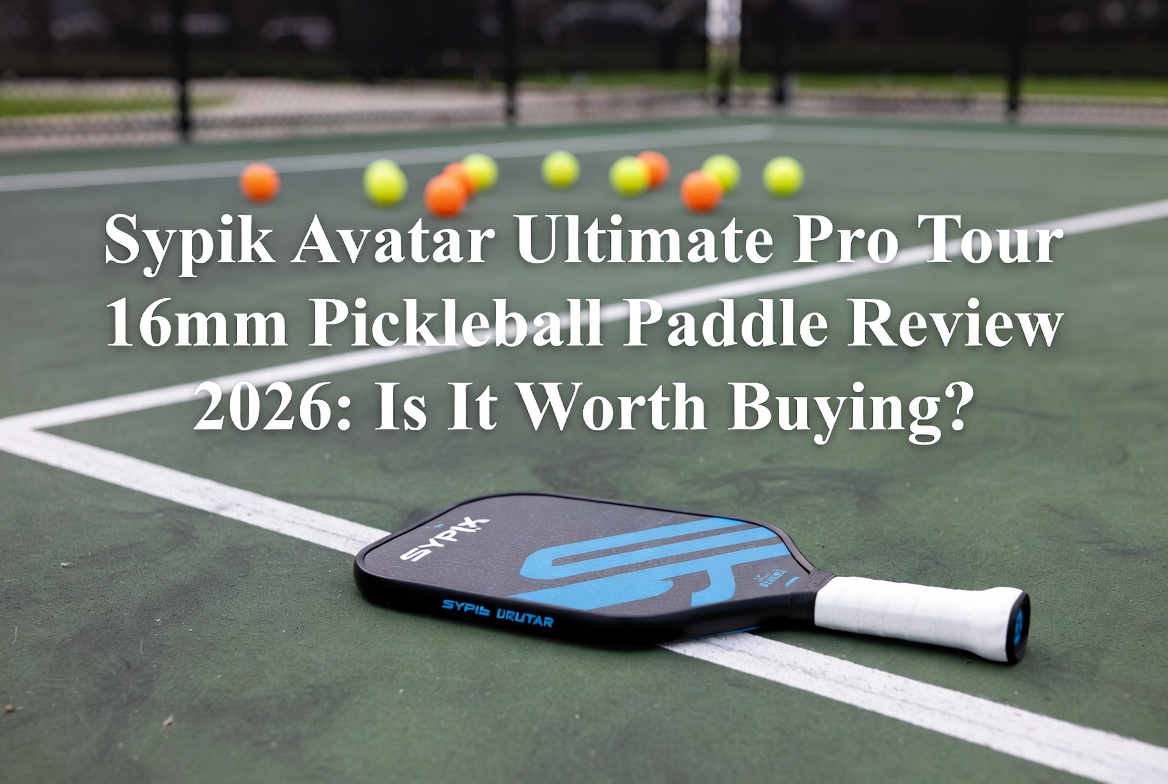
The Sypik Avatar Ultimate Pro Tour 16mm pickleball paddle has drawn attention because the model name highlights a 16mm core thickness — a design choice that influences feel, power and forgiveness. If you’re weighing whether this paddle is “worth buying,” this long-form guide steps through what 16mm paddles tend to offer, how that affects different shots, who benefits most, realistic pros and cons, and how it compares to sensible alternatives. You’ll also get practical drills, setup and shot-tuning advice so you can decide with confidence.
Affiliate disclosure: This article mentions paddles and links to categories on pickleball-paddles.org. Some links may be affiliate links, which means this site may earn a commission if you buy through them at no extra cost to you. Recommendations are based on play-style and category characteristics, not on affiliate relationships.
Quick verdict: Who should consider the Sypik Avatar Ultimate Pro Tour 16mm?
Because the Sypik model name specifies a 16mm thickness, the paddle will most closely match the typical characteristics of the 16mm category: increased dwell time, a firmer/responsive feel, and a tendency toward more power and stability compared with thinner paddles. If you are a player who likes a bit more pop on drives and smashes, appreciates a stable paddle for volleys, or prefers a forgiving sweet spot for mid-court rallies, a 16mm paddle like this is worth considering.
If you are new to the game, prefer the soft touch required for delicate dinks, or primarily want a lighter paddle for wrist-friendly control, you may prefer thinner (e.g., 14mm) or dedicated control paddles. For quick entry to alternative paddle families, browse our 16mm pickeball paddles category and related collections such as control pickleball paddles.
What “16mm” actually means for play
Thickness affects the core volume and how the paddle transfers energy between ball and player. 16mm paddles usually have:
- Greater dwell time — the ball stays on the face a touch longer, which helps add spin and sometimes control on third-shot drops.
- More stability — a thicker core often reduces vibration and helps with consistent placements on volleys and drives.
- More power potential — with more core material, many 16mm designs return energy in a way that can produce easier power when you swing through your shots.
That said, thickness is only one factor. Face material, core type, paddle shape and weight distribution all change how the paddle performs. Because we must avoid inventing specific specs, treat the 16mm designation as a strong indicator of the paddle’s general personality rather than a complete description.
How the Sypik Avatar Ultimate Pro Tour 16mm will likely influence common shots
Below are practical expectations tied to the 16mm thickness, with tips for adapting technique.
Dinks and soft touch
Expect slightly more dwell and a bit more “grab” on soft shots. That helps control, but don’t mistake more dwell for automatic perfection — you still need soft wrists and proper placement. To preserve the soft touch at the kitchen line, shorten your backswing and focus on contact in front of your body.
Third-shot drops
16mm paddles can help because of the dwell time and added forgiveness. Aim for a gentle, consistent contact and use more wrist hinge at the top of the swing to control trajectory. If the paddle’s face is on the firmer side, make sure to neutralize excessive power by decelerating through contact.
Drives and overheads
These shots typically benefit from the added pop a 16mm core supplies. Work on accelerating through the ball, keeping your swing compact, and using the paddle’s stability to find the sweet spot. Remember that added power can raise the risk of popping the ball up—so maintain downward direction and follow-through.
Volleys and blocks
The thicker core usually increases stability at the net, which helps tight blocking and short volleys. Use short, compact punches and keep your paddle slightly above the wrist to absorb and redirect pace.
Pros and cons (generalized for a 16mm paddle like the Sypik Avatar Ultimate Pro Tour)
The list below uses the thickness attribute as the primary basis for pros and cons. Specific Sypik design choices (such as face texture, exact weight or grip circumference) are not assumed or invented.
Pros
- More power potential on serves, drives and overheads.
- Good stability and forgiving sweet spot for volleys and counterpunching.
- Increased dwell time can help with spin and controlled third-shot drops.
- Generally versatile — fits players who want a blend of power and control.
Cons
- May feel slightly less maneuverable than thin-core paddles for rapid wrist plays.
- Could be too lively for players who rely on ultra-soft touch and minimal pop.
- Not necessarily the lightest option — check actual weight before buying if wrist/shoulder strain is a concern.
How the Sypik Avatar Ultimate Pro Tour compares to other paddles in the same category
Rather than inventing specs for specific competing models, the comparison below describes common trade-offs across 16mm and nearby categories, then provides recommended alternatives and where to explore them on our site.
| Characteristic | Sypik Avatar Ultimate Pro Tour (16mm) | Typical 14mm / thinner paddles | Dedicated control paddles |
|---|---|---|---|
| Power | Higher power potential due to 16mm thickness | Lower power; favours precision and wrist play | Lower power; designed for touch and placing dinks |
| Forgiveness / Sweet spot | Generally forgiving and stable | Smaller sweet spot; requires cleaner contact | Engineered to give consistent touch on soft shots |
| Maneuverability | Good, though slightly less nimble than thin-core paddles | High maneuverability and wrist responsiveness | Balanced, but optimized for control not raw maneuver speed |
| Ideal player | Intermediate and competitive players wanting power + control balance | Players prioritizing finesse, fast hands, and dinking specialists | Players who prioritize dinks, third-shot drops, and consistency |
Where to look for comparable paddles and alternatives
If you want to shop models with a similar 16mm profile or look for a tighter control or different materials, these category pages are good starting points:
- 16mm pickleball paddles — curated paddles that emphasize the thicker-core play traits discussed above.
- 14mm pickleball paddles — if you want lighter touch and quicker maneuverability.
- Control pickleball paddles — optimized for dinks and precise placement.
- Graphite pickleball paddles and carbon fiber pickleball paddles — if face material is a major deciding factor for feel and response.
- Advanced pickleball paddles — for players seeking higher-performance options and features.
Choosing between the Sypik Avatar Ultimate Pro Tour 16mm and other options: a practical checklist
Use this checklist to evaluate whether the Sypik (or any 16mm paddle) fits your needs. Ask these questions before you buy.
- What is my primary play style? (Aggressive drives/overheads vs. dinks/third-shot drops.)
- Do I prefer a paddle that helps produce power or one that promotes softer touch?
- How important is maneuverability and quick wrist action for my game?
- Do I have wrist, elbow, or shoulder concerns that might make a lighter paddle preferable?
- Will I play mostly indoor or outdoor? (Surface and ball speed can influence how a paddle feels.)
- What grip size feels comfortable for extended play? (A paddle that fits your hand avoids compensations in stroke mechanics.)
- Can I demo the paddle or a similar 16mm model before buying? Trying it on-court is best.
How to adapt your game to a 16mm paddle: step-by-step advice and drills
If you switch to a 16mm paddle like the Sypik Avatar Ultimate Pro Tour, here are practical drills and technique adjustments to get the most from it.
1) Adjust your grip and contact point
Goal: Maintain control while taking advantage of added dwell and power.
- Reduce unnecessary wrist movement at the kitchen line — use shorter, controlled motions.
- Practice hitting dinks with contact slightly in front of the leading hip; with a 16mm paddle you may feel more response, so make contact earlier and let the paddle do the work.
- For drives, take a compact backswing and accelerate through contact; avoid swinging harder simply because you get more pop.
2) Dink consistency drill (10 minutes)
- Stand at the non-volley line with a partner or a ball machine.
- Use only wrist and forearm motion to keep the ball low and consistent for two minutes without letting the ball pop up.
- Repeat while shortening your contact time. A 16mm paddle’s dwell helps but you should still emphasize soft touch.
For more on dink technique, see our in-depth guide: How to Master the Pickleball Dink Shot.
3) Third-shot drop progression
Goal: Use the 16mm paddle’s dwell to improve drop consistency without overshooting.
- Start with mid-court feeds. Use a crouched stance and swing with a short arc to focus on placement.
- Practice adjusting contact angle and decelerating through the ball to remove extra power.
- Progress to deeper feeds and live feeds that force you to control the shot under pressure.
For a structured plan and drills, check our Third Shot Drop Guide.
4) Volleys and blocks (net play)
- Work on compact punch volleys — keep elbows in and paddle up to absorb pace.
- Practice flashing quick exchanges at net with short reaction volleys to exploit the paddle’s stability.
5) Drives and overheads
- Use target practice: short drills hitting crosscourt and down-the-line targets while focusing on staying low and generating horizontal acceleration.
- Do not over-swing. Let the 16mm core supply extra energy by keeping your swing efficient.
Common mistakes players make when switching to a 16mm paddle — and how to fix them
- Mistake: Swinging harder because the ball feels more powerful.
Fix: Shorten your swing and focus on direction. Practice drop and dink drills where power is penalized. - Mistake: Not adjusting contact timing, resulting in popped-up balls.
Fix: Move contact slightly forward and practice decelerating through the ball on soft shots. See our post on how to stop popping the ball up: How to Stop Popping the Ball Up in Pickleball. - Mistake: Relying on the paddle for touch without proper footwork.
Fix: Prioritize footwork drills to put your body in position to use the paddle’s characteristics effectively. Try our footwork drills: Pickleball Footwork Drills to Improve Speed and Balance.
Maintenance, care and buying tips (practical)
- Check grip size before purchase — a too-small grip leads to over-gripping; too-large reduces wrist action.
- Consider a demo or loaner if available. On-court time beats manufacturer descriptions.
- Use a paddle cover to protect the face and edge guard. Cleaner faces maintain consistent ball response.
- Avoid leaving your paddle in hot cars or outdoors for long periods — temperature extremes can affect the core and face material.
Recommended alternatives by play-style
If you like the idea of the Sypik Avatar Ultimate Pro Tour 16mm but want to explore similar or contrasting options, consider these directions and linked categories:
- If you want a similar 16mm feel but from different materials or brands: Browse the 16mm pickleball paddles collection to compare face materials, grip choices and paddle shapes.
- If you prioritize softer touch/dink control: Look at control pickleball paddles or thinner-core options like our 14mm paddles.
- If you want a light, fast paddle for quick wrist play: Explore thinner cores or materials that emphasize low swing weight within the graphite and carbon fiber categories.
- If you’re an advanced player seeking premium performance: Check the advanced pickleball paddles selections for refined designs and features that target competitive play.
Buying checklist before you hit “add to cart”
- Confirm actual paddle weight (not assumed from thickness) to ensure comfort during long sessions.
- Verify grip circumference — choose the one that allows a light-but-secure hold.
- Read product images and descriptions for face material, edge guard type, and whether the paddle has a textured face for spin.
- Check return policy and demo opportunities — exchange or trial gives peace of mind.
- Compare similar models in the same price band to ensure you’re getting the features you value most.
Conclusion: Is the Sypik Avatar Ultimate Pro Tour 16mm worth buying?
If you’re an intermediate or competitive player who seeks a balanced paddle that leans toward power, stability and a forgiving sweet spot, a 16mm model like the Sypik Avatar Ultimate Pro Tour can be a very good fit. The thickness suggests enhanced dwell, more pop on drives, and generally stable net play — traits many players appreciate when moving up from thinner paddles.
However, a paddle should match your stroke mechanics and physical comfort. If you predominantly play soft dinks or need very light paddles for wrist/shoulder comfort, consider looking at 14mm or dedicated control paddles. Because specifications beyond the 16mm thickness are model-dependent, try to demo or confirm key details—actual weight, face material and grip size—before committing.
Use the internal categories on our site to compare options and narrow your search: 16mm paddles, control paddles, and graphite paddles are good places to start.
FAQ
1. Will a 16mm paddle like the Sypik Avatar Ultimate Pro Tour help my third-shot drops?
A 16mm paddle often provides a touch more dwell and forgiveness, which can help make third-shot drops more consistent. That benefit is not automatic—technique, contact timing and placement remain the most important factors. Use targeted third-shot drop practice to integrate the paddle’s feel into your stroke.
2. Is a 16mm paddle better for indoor or outdoor play?
Thickness itself isn’t a strict indicator of indoor vs. outdoor suitability. The main considerations are face texture and overall weight. Indoor balls can be faster and require softer touch; outdoor balls are heavier and wind-affected. Try the paddle in the environment where you play most often to assess how it performs.
3. Will a 16mm paddle increase my risk of popping the ball up?
Not inherently, but increased power potential can tempt players to swing harder. The common cause of popping is poor contact timing or an overly vertical swing. Shorten your motion and focus on a late, soft contact to prevent popping.
4. How much does grip size matter with a 16mm paddle?
Grip size matters for all paddle types. A proper grip allows you to use wrist actions effectively and reduces compensatory movements that can lead to inconsistent shots or discomfort. Measure your grip or test several sizes if possible before buying.
5. Can a beginner use a 16mm paddle?
Yes, beginners can use a 16mm paddle, but it depends on priorities. If a newcomer wants a forgiving sweet spot and some extra power to keep rallies going, a 16mm can be helpful. If a beginner focuses on soft touch and rapid maneuvering without added pop, a thinner or control paddle might be simpler to start with.
6. How should I maintain a 16mm paddle?
Keep it in a paddle cover when not in use, avoid leaving it in hot or humid environments, wipe it clean after dusty outdoor sessions, and inspect the edge guard for dings. Proper care preserves consistent feel and prolongs face integrity.
7. Should I choose based on brand name or play-style?
Prioritize play-style, feel and fit (weight/grip/shape) over brand name. Brand matters for build quality and warranty, but the paddle that matches your technique and court needs will help your game most. Use brand and category pages to compare options that match your preferred characteristics.
If you’d like, tell me what your current paddle is, your playing level and what you want to improve (more power, better dinks, less arm strain), and I’ll provide a tailored short list of paddles and training tips that suit your needs.